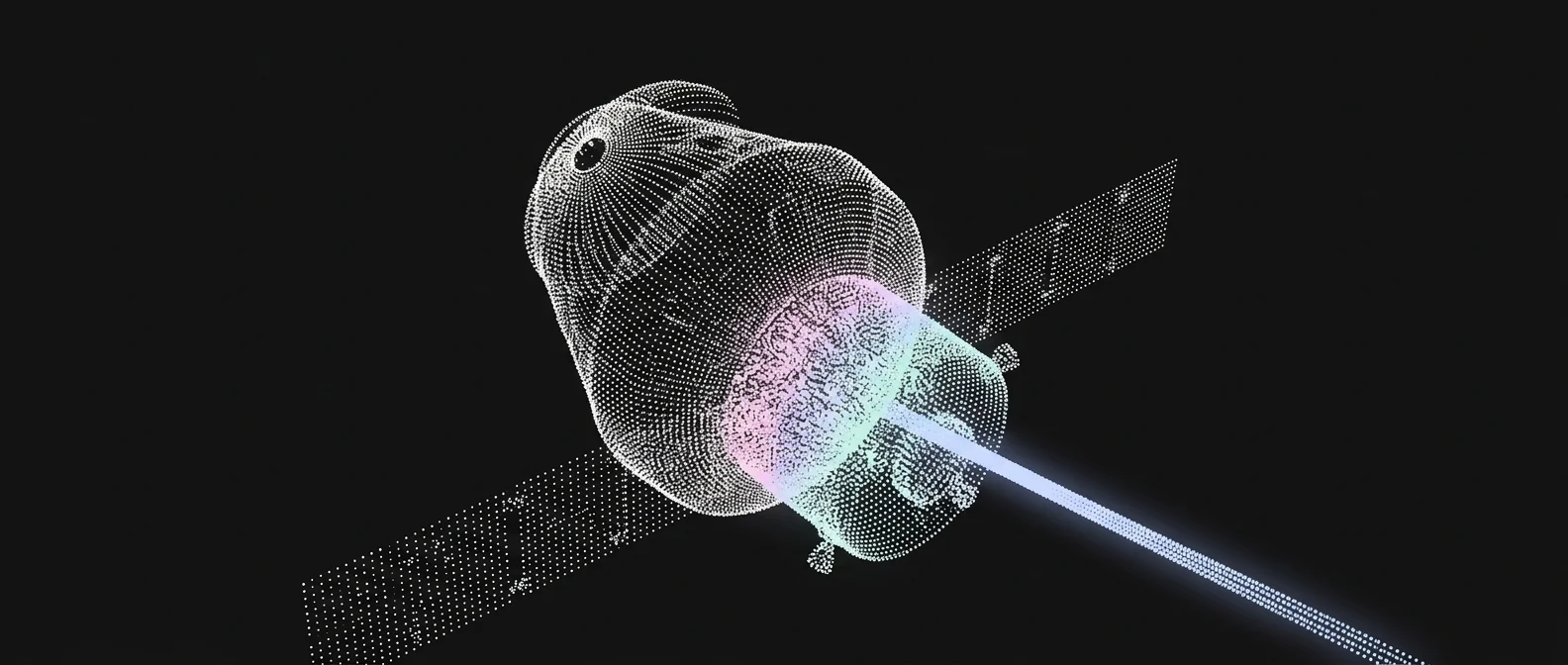
NASA transitions lunar laser communications to operational status as Artemis II downlinks 450 gigabytes
The Orion spacecraft sustained 260-megabit-per-second optical links from lunar orbit, quietly shifting deep-space bandwidth from a bottleneck to a commodity.

Deep space communications have formally transitioned from radio-frequency scarcity to optical abundance. During the 10-day Artemis II mission this month, NASA's Orion spacecraft relied on an infrared laser terminal to transmit over 450 gigabytes of data to Earth. This marks the first time optical links served as operational infrastructure for a crewed lunar flight rather than a standalone technology demonstration, fundamentally altering the data economics of deep-space exploration.
The mechanism behind this shift relies on moving from the broad, diffuse beams of traditional radio frequency to tightly focused near-infrared light. Because optical wavelengths are significantly shorter, the Orion Artemis II Optical Communications System (O2O) can pack exponentially more data into a single transmission. The system operated in parallel with traditional radio, tying into the same ground networks at the Mission Control Center in Houston. Engineers developed custom multiplexingThe process of combining multiple distinct data streams or signals into a single transmission over a shared medium, allowing different systems to communicate simultaneously without interference. solutions to allow both systems to work together, ensuring the higher data rates integrated seamlessly into existing flight control software.
The performance delta between the two architectures is stark. The optical terminal sustained downlink speeds of up to 260 megabits per second from the lunar vicinity—roughly 100 times the capacity of standard radio links used on previous deep-space missions. This bandwidth allowed the crew to transmit uncompressed 4K video, extensive flight telemetryThe automated collection and transmission of data from remote or inaccessible sources to an IT system in a different location for monitoring and analysis., and high-fidelity science data in minutes rather than hours. More importantly, it effectively freed the legacy radio channels to serve exclusively as a robust, low-latency pipeline for critical command streams and emergency telemetry.
The immediate winners are the scientific payloads and instrument designers who no longer have to ruthlessly compress or discard data before transmission due to downlink bottlenecks. The secondary beneficiaries are the commercial ground-station operators positioning themselves to catch optical downlinks as NASA expands its network. The losers are the legacy radio-frequency component manufacturers whose deep-space monopolies are now structurally threatened, alongside the traditional Deep Space NetworkNASA's international array of giant radio antennas that provides the primary communications link for interplanetary spacecraft missions and some Earth-orbiting satellites. scheduling apparatus, which must now adapt to a bifurcated architecture of high-volume optical bursts and steady-state radio.
The Artemis II milestone forecloses the argument that laser communications are too susceptible to atmospheric interference or pointing-accuracy challenges to serve as primary mission infrastructure. What it opens is a fundamental redesign of deep-space mission architectures. When bandwidth is no longer the absolute constraint on a spacecraft's design, the limiting factor for future lunar and Martian outposts shifts entirely from how much data a probe can send home to how much power it can generate to keep the lasers firing.