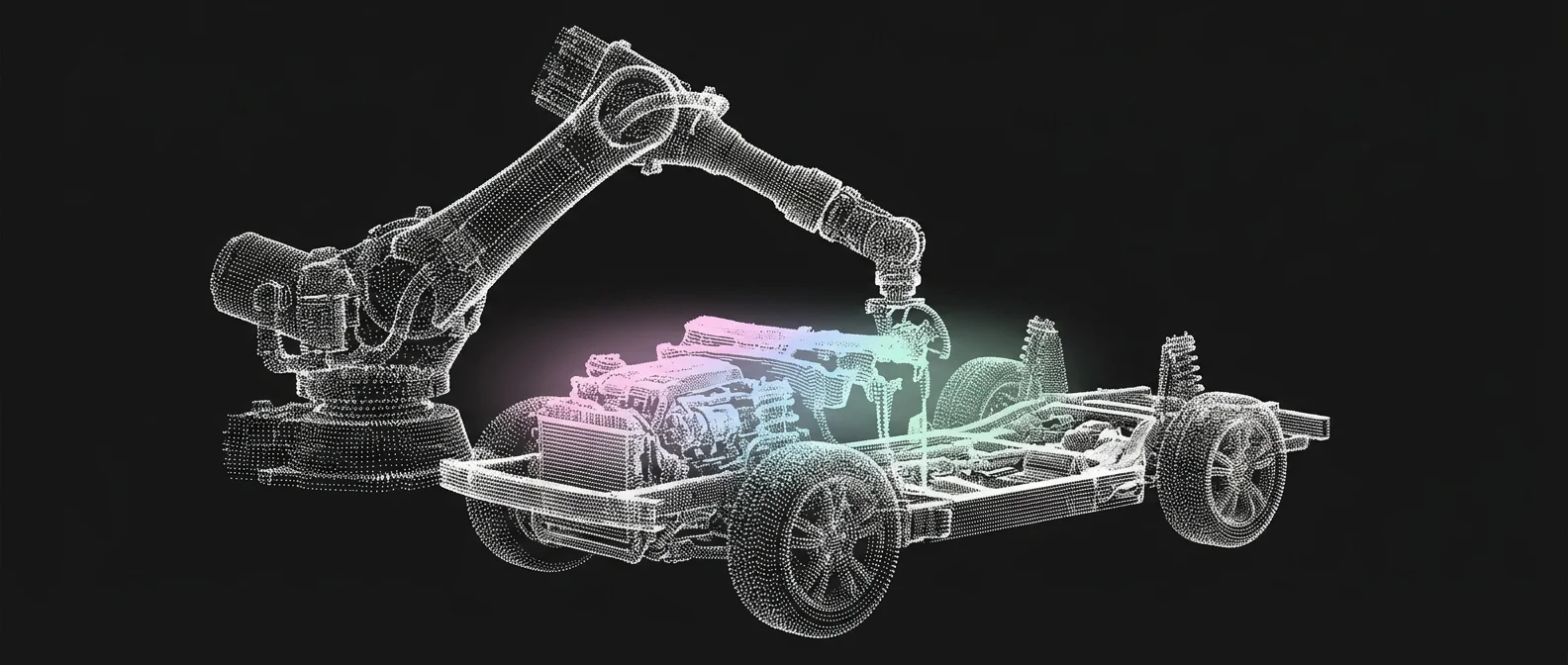
NVIDIA standardizes synthetic training environments for industrial robotics as the sim-to-real gap collapses to one percent
The deployment of OpenUSD-backed simulation layers at ABB and JLR suggests the bottleneck for physical AI is no longer the hardware, but the fidelity of the synthetic worlds where it learns.

The traditional sequence of industrial manufacturing — design, build, then test in the physical world — has quietly inverted. NVIDIA’s deployment of its Omniverse libraries across major industrial partners demonstrates that synthetic training data is now accurate enough to serve as the primary proving ground for physical AI. The digital twinA highly accurate virtual replica of a physical object, system, or environment used to run simulations, monitor real-time performance, and train AI models before physical deployment. is no longer a shadow of the factory; it is the environment where the factory’s reasoning models are forged, shifting the burden of proof from steel to silicon.
The mechanism driving this inversion is a standardization of how physical properties are encoded. Historically, when a three-dimensional asset moved from a computer-aided design tool to a simulation platform, its geometry and physics metadata degraded, forcing teams to rebuild the environment from scratch. By backing the SimReady content standard on OpenUSD, NVIDIA ensures that assets retain their exact physical accuracy across rendering and AI training pipelines. A robot simulated in this environment runs the exact firmware it will run on the floor, experiencing synthetic variations in lighting and geometry that would be economically impossible to replicate manually.
The resulting compression of the engineering cycle is material, moving beyond theoretical gains into deployed metrics. ABB Robotics, integrating these libraries into a simulation platform used by 60,000 engineers globally, reports a 99 percent accuracy rate when translating simulated behaviors to physical hardware. That fidelity translates to an 80 percent reduction in commissioning time and a halving of product introduction cycles. Similarly, at JLR, neural surrogate modelsLightweight neural networks trained to approximate the outputs of a much slower, highly complex physics simulation, allowing for near-instantaneous testing and iteration. trained on tens of thousands of wind-tunnel-correlated simulations have collapsed aerodynamic testing workflows from four hours to a single minute.
The winners in this shift are the software-first integrators like Tulip, which is currently deploying vision language modelsMultimodal artificial intelligence systems capable of processing and understanding both visual inputs, like live camera feeds, and text, allowing them to describe or reason about physical scenes. across forty Terex plants to parse live camera feeds and operator behaviors into structured intelligence, projecting a 3 percent yield increase. The losers are the legacy industrial hardware providers whose business models rely on extended, iterative physical prototyping and bespoke on-site commissioning. When the testing phase moves entirely into the compute layer, the commercial value of physical iteration drops to zero.
What this forecloses is the assumption that physical robotics will scale at the slow, deliberate speed of physical manufacturing. What it opens is an era where a factory’s operational intelligence is fully mature before the foundation is poured. If a reasoning modelA large language model trained (or post-trained) to spend variable compute on intermediate steps before producing a final answer. Distinguished from pure next-token models by the visible scratchpad. derives its entire understanding of physics from a synthetic construct, what happens when it encounters an edge case the simulation failed to imagine?