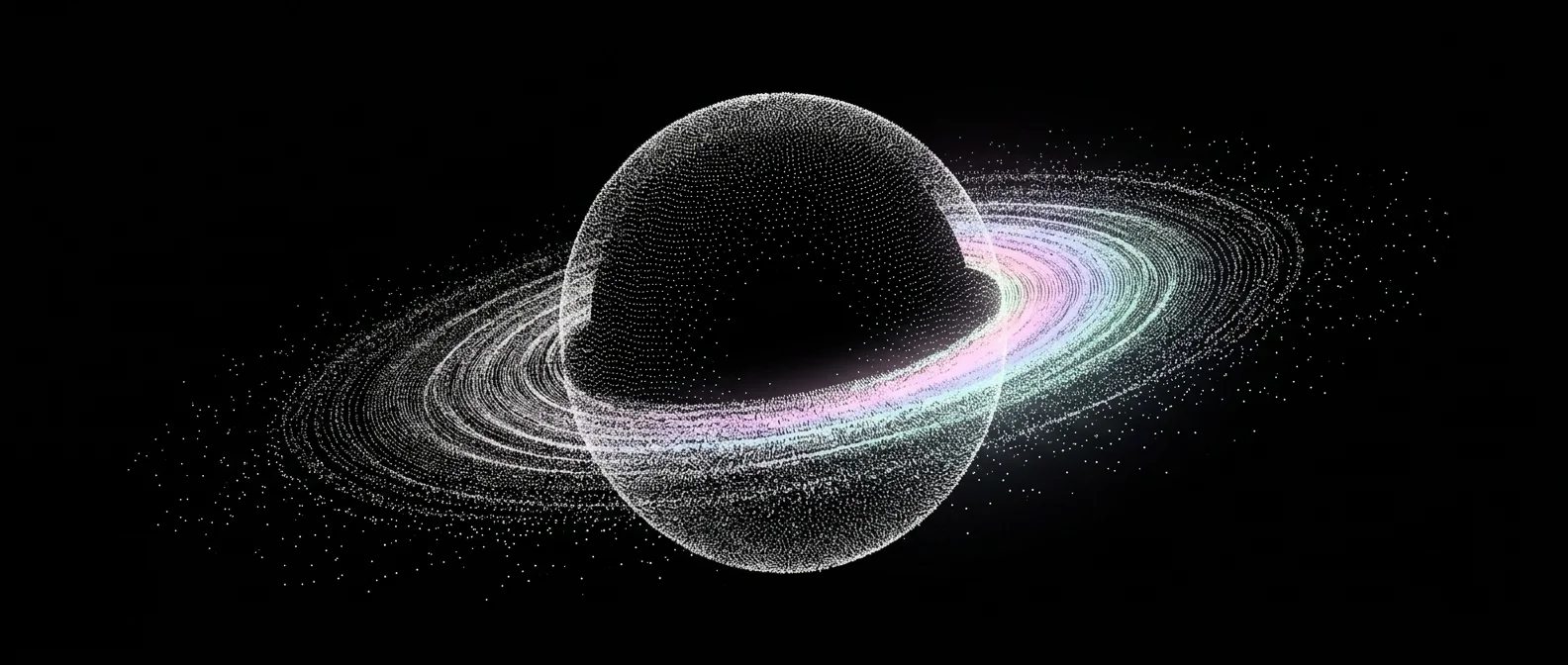
UC Riverside models dark matter decay as JWST telemetry breaks the standard accretion timeline
Standard models require a billion years to form supermassive black holes. A 24–27 electronvolt particle mass range offers a thermal shortcut.

Twenty-four to twenty-seven electronvolts is the energy margin required to collapse a primordial gas cloud without stellar ignition. The James Webb Space Telescope has consistently downlinked telemetryThe automated collection and transmission of data from remote or inaccessible sources to an IT system in a different location for monitoring and analysis. showing supermassive black holes fully formed 500 million years after the Big Bang—an operational reality that breaks the standard accretion sequence. To reconcile the instrument’s data with the physical limits of the early universe, a UC Riverside team has proposed that decaying dark matter provided the missing thermal injection.
The structural problem is strictly one of time and energy. Standard accretion models require at least one billion years for massive stars to form, burn through their main sequence, die, and merge their remnants into supermassive scales. A direct collapse of pristine hydrogen gas offers a theoretical shortcut, but only if the cloud is heavily irradiated by an external energy source to prevent early fragmentation. With insufficient starlight available in the early cosmos to provide that radiation, researchers Yash Aggarwal and Flip Tanedo modeled dark matter decay as the necessary catalyst.
The proposed mechanism narrows the hypothetical dark matter particle mass to a strict 24 to 27 electronvolt range. At this mass, the particles decay and release a microscopic energy yield. When aggregated across the 85 percent of cosmic mass that dark matter comprises, this decay provides exactly the thermal pressure needed to supercharge the collapse of hydrogen gas. The math closes the gap between what the observatory physically images and what the physics of the early universe previously allowed.
The immediate winners are observational cosmologists, who gain a mathematical bridge between the high-redshift structures the telescope is actually detecting and the physical laws that govern them. The losers are theorists bound strictly to the Standard Model of particle physics. The 24–27 eV energy requirement demands a particle class that interacts with baryonic matter, exchanging energy beyond simple gravitational influence, which forces a revision of baseline assumptions.
What this milestone forecloses is the assumption that dark matter is entirely inert, acting only as a passive gravitational scaffold for early galaxy formation. What it opens is a functional reclassification of the universe’s first supermassive black holes. They are no longer treated merely as gravitational anomalies; they are now the largest available detectors for the decay signatures of the early cosmos.