
$4 billion of capital and roughly one gigawatt of dispatch obligation went looking for a home in Nobles County last month, while 57.6 gigawatt-hours of utility-scale battery storage hit the US power system across 2024–2025. Meanwhile, developers like QumulusAI are deploying 21,000 Blackwell GPUs behind the meter, powered directly by onsite gas turbines. The financial consensus reads this as a temporary supply-chain friction. From the dispatcher’s console, it reads as a structural ceiling. The market assumes that capital can simply purchase electricity if the price is right. The physical reality is that capital can only purchase what the transmission system can physically deliver, and the wires are full.
We have spent fifteen years treating the energy transition as a procurement exercise — subsidizing the raw deployment of solar panels and wind turbines. The result is a historic overcapacity of intermittent generation. In India, 98 terawatt-hours of new renewable generation outpaced total national demand growth last year, forcing legacy thermal plants into overnight balancing duty. Solar has officially become the world’s largest source of primary energy, shifting from an additive resource to a substitutive one. But generation is only half the settlement. The grid carries the obligation to match that generation to load at every second, and it is running out of physical room to maneuver.
The bottleneck has officially moved from the panel to the wire. Megawatts are not megawatt-hours, and nameplate capacity is meaningless if the local substation cannot absorb the ramp. When a hyperscaler proposes a data center, they are not just asking for energy; they are asking for a massive, unyielding dispatch obligation — a constant, flat draw that ignores the weather. When that project is rejected, it is because the local infrastructure cannot absorb the physical strain. Operations precedes economics. The transition will no longer be gated by how many gigawatts of solar China can manufacture, but by how many miles of high-voltage transmission and utility-scale storage facilities can survive the permitting process.
The transition will no longer be gated by how many gigawatts of solar China can manufacture, but by how many miles of high-voltage transmission and utility-scale storage facilities can survive the permitting process.
The geographic blockade. The resistance to this physical expansion is organizing itself at the township level, weaponizing the permitting process against the physics of the system. In Ohio, fossil fuel proxy groups are funding local referendums to maintain strict zoning bans on utility-scale renewables, effectively freezing out new generation “county by county.” The grid we are asking to carry this load cannot bypass a county commissioner. Developers are facing a patchwork of localized blockades that treat solar farms, wind installations, and data centers with equal hostility. Richland County residents forced a ballot referendum to overturn a restriction, but the campaign to maintain the ban is financially anchored by natural gas advocates. The zoning map is becoming the ultimate arbiter of the dispatch curve.
Because the traditional utility model cannot build infrastructure fast enough to bypass these blockades, the largest consumers are stepping in to underwrite the system themselves. Meta recently secured a one-gigawatt capacity reservation from Noon Energy for a 100–120 hour storage chemistry based on carbon and oxygen. They are bypassing lithium-ion supply chains entirely — preparing for a 2028 pilot delivery. Hyperscalers are replacing utilities as the primary underwriters for unproven, grid-scale storage technologies because they cannot wait for the regulated market to catch up. The grid carries the risk of these new chemistries because the alternative is a localized blackout or a stranded billion-dollar facility.
We are entering an era of deep operational fragmentation. Texas is preparing to overtake California as the primary storage market by late 2026, driven entirely by the need for dispatchable battery-based capacity to manage extreme ramps. The ERCOT system is installing storage not for environmental optics, but out of sheer operational necessity. The system is no longer a unified machine; it is a collection of high-friction battlegrounds where megawatts get translated into permits, and where failure means a facility sits idle. The grid no longer carries. It redistributes the pain of local blockades onto the remaining flexible assets, forcing the dispatcher to squeeze ever-tighter margins out of an aging thermal fleet.
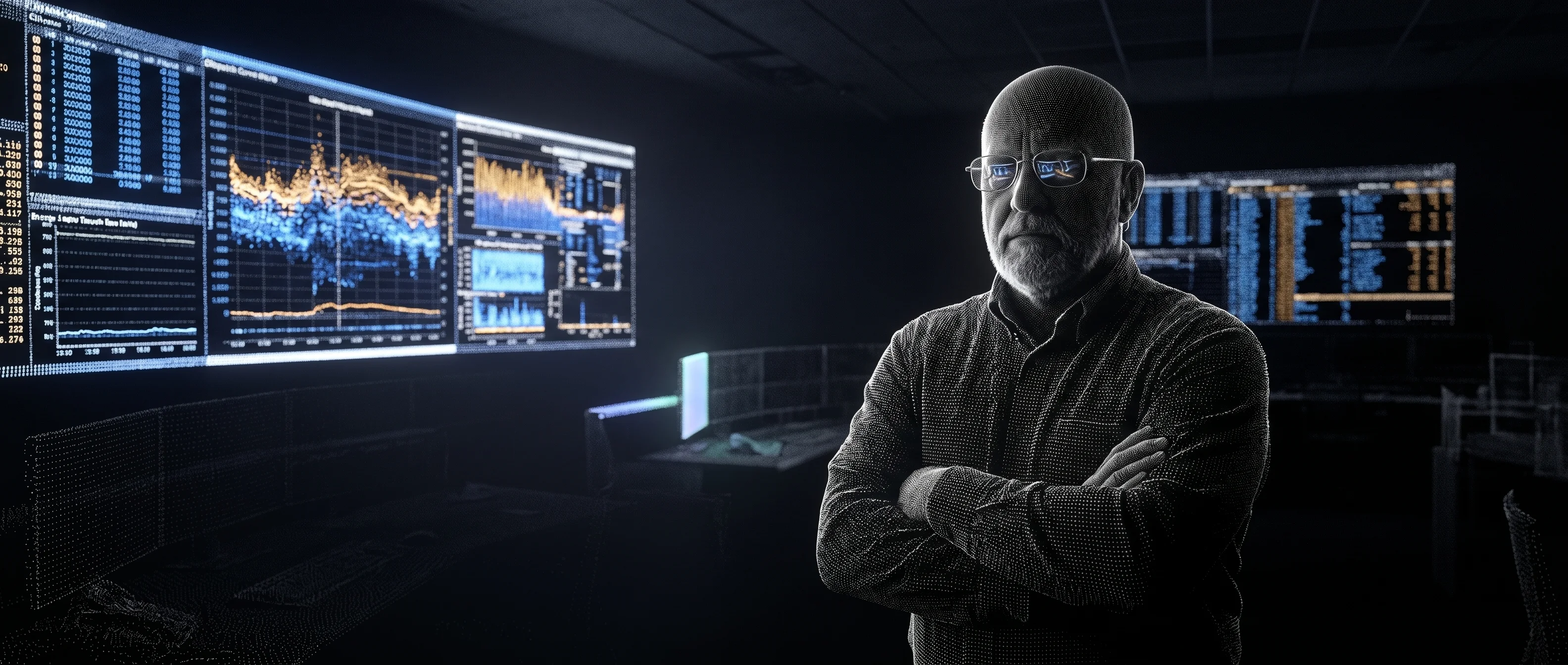
— At the ERCOT control center in Taylor, the night-shift dispatcher watches the evening ramp on the main display, tracking the exact second the localized battery fleet discharges to catch the falling solar curve.