



The gravel on County Road 35 is thick with early spring dust, and the 959-acre parcel stretching south toward the Iowa border is still planted with soybeans. The galvanized chain-link that typically precedes a heavy industrial build-out is entirely absent—there is no security trailer, no freshly cut top rail, and no perimeter access road graded for heavy equipment. From outside the fence, the site is exactly what the agricultural preservation code says it is. The $4 billion Geronimo Power data center was supposed to break ground here, drawing up to a gigawatt of capacity to train the next generation of frontier models. Instead, it remains unbroken dirt, a testament to the friction of local governance.
The mechanism that stopped it was not a lack of silicon, nor was it a failure of network engineering. It was a conditional use denial. Nobles County commissioners voted against Text Amendment 26-04 that would have allowed hyperscale compute on protected soil. For the past decade, the standard playbook for data center expansion relied on identifying cheap, flat land near robust power routes, assuming local governments would rubber-stamp the variances in exchange for tax revenue. The Nobles County vote suggests that playbook is losing its efficacy as the physical footprint of these facilities expands beyond municipal tolerance. The boardroom projections mean nothing if the planning commission will not grant the easement.
The bottleneck for artificial intelligence has officially moved. It is no longer a question of securing graphics processing units or optimizing tensor operations; the argument is now entirely in the land use. Financial analysts tracked 25 data center cancellations in the 2024–2025 cycle—a fourfold increase from the prior year, driven by 60-week lead times for switchgear, utility grid capacity constraints, and organized local opposition across forty states. The hyperscale model requires contiguous land and continuous power draws equivalent to mid-sized cities. When those requirements collide with rural zoning codes, the permit is the policy.
The local resistance is also arming itself with new, peer-reviewed metrics to bring to the hearing room. In Alberta, researchers recently tied 18-hertz infrasound from industrial cooling arrays to involuntary cortisol spikes, dismantling the developer defense that sub-audible emissions cannot cause biological harm. For decades, operators of data centers and wind farms successfully defended a setback variance by proving their acoustic emissions fell below conscious human hearing thresholds. Now, the burden of proof is shifting. Once physiological stress enters the environmental impact statement, the setback calculations must be redrawn entirely. Outside the fence, the neighbor's bloodstream is now part of the regulatory record.
The boardroom projections mean nothing if the planning commission will not grant the easement.
Because the front door of municipal zoning is closing, the industry is routing around it. If a gigawatt facility cannot clear the hearing room, the compute must be fragmented to survive. Independent operators are now networking eight NVIDIA GB10 nodes through commodity MikroTik switches, bypassing the hyperscaler data centers entirely. By pooling memory across off-the-shelf networking gear, enterprise-scale inference no longer strictly requires enterprise-scale facilities. Similarly, infrastructure upstarts are deploying massive GPU clusters in modular, behind-the-meter natural gas enclosures—actively avoiding the multi-year utility grid interconnection delays that currently plague centralized campuses.
We are watching a structural retreat from the public square. When infrastructure developers cannot secure the physical right-of-way, they enclose what they already control. Arizona State University unilaterally reclassified decades of recorded faculty lectures as an institutional data asset—running them through a generative pipeline without consent to build synthetic course modules. The university treated its server architecture as an unexploited right-of-way, bypassing the labor friction entirely. In Austin, SXSW deployed automated trademark enforcement to mass-report dissenting Instagram posts, erecting an unappealable digital perimeter against local criticism. When the physical build-out stalls, the extraction turns inward, leveraging intellectual property law to clear the space that physical zoning protected.
This fragmentation fundamentally changes who holds the leverage. When infrastructure was centralized, it was visible, and it was subject to the planning record. Researchers are currently geolocating undisclosed data centers by cross-referencing satellite imagery with county permits, forcing a public ledger of actual power draw. But as enterprise inference moves into local studio racks, and as automated systems sanitize the digital feeds, the perimeter dissolves into the background. If it has not been built at scale, it cannot be contested in the hearing room. There is no outside the fence when the infrastructure is small enough to hide by right.

Independent labs network eight NVIDIA GB10 nodes for local inference as commodity switches bypass the cloud

University of Alberta researchers link 18-hertz infrasound to physiological stress as the finding arms zoning boards against industrial setbacks

SXSW deploys BrandShield to clear Instagram feeds as automated trademark enforcement bypasses the appeals process

Arizona State University reclassifies lecture archives as training data as the Atomic platform bypasses faculty consent
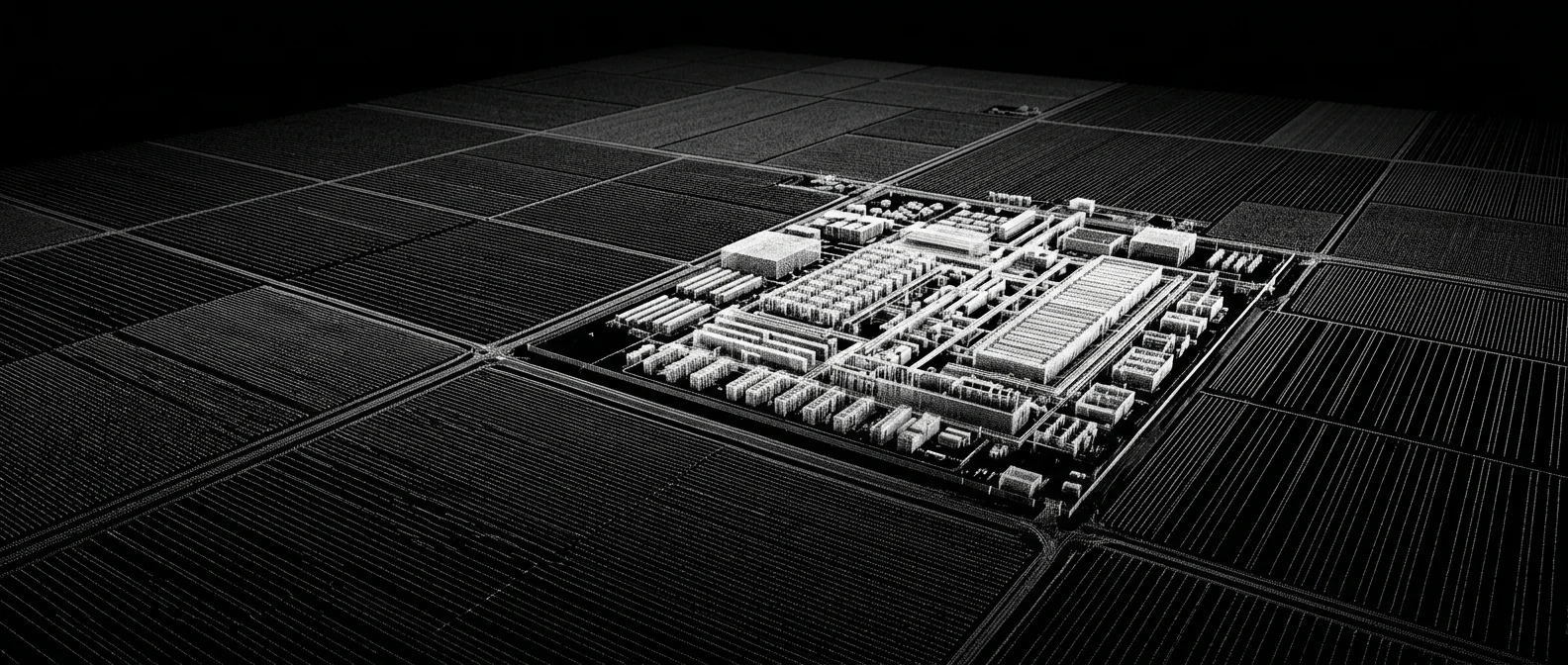
Nobles County rejects a $4 billion Geronimo data center as rural zoning codes halt gigawatt-scale infrastructure