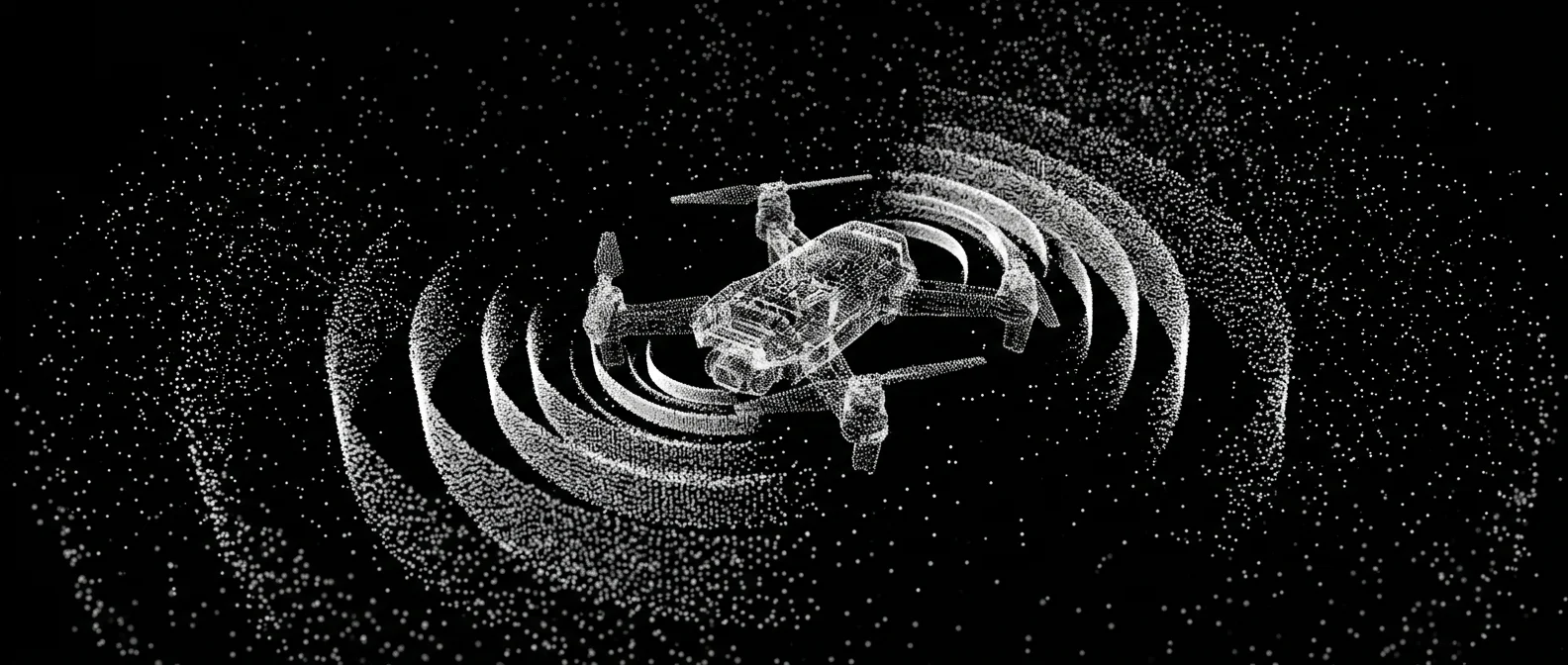
Worcester Polytechnic Institute ships a milliwatt sonar payload for micro-drones as acoustic shielding bypasses the propeller noise floor
A physical cartilage analogue and a neural recovery network allow aerial platforms to drop lidar for echolocation, cutting sensor power draw by three orders of magnitude.

The perception bottleneck for micro-aerial vehicles is no longer the weight of the sensor, but the acoustic interference of the platform itself. Researchers at Worcester Polytechnic Institute have bypassed that limit, deploying an ultrasound-based perception system that allows tiny drones to navigate visually degraded environments using milliwatt-level sensing power. The system drops the traditional camera and lidar payload in favour of echolocation, achieving a stable flight envelope in total darkness, smoke, and simulated snowfall.
The challenge of aerial sonar is the signal-to-noise ratio—listening for a faint ultrasonic bounce while four rotors generate a constant, high-decibel wash immediately adjacent to the receiver. WPI’s architecture solves this through a dual-hardware-software approach. A physical acoustic shield, modelled on bat ear cartilage, mechanically isolates the sensor from the rotor wash. Downstream of the receiver, a neural network named Saranga processes the remaining interference, recovering the weak echo signals from the noise floor to build a three-dimensional map of the environment.
The resulting hardware swap alters the fundamental duty cycleThe fraction of time a machine or system is actively operating. In electric motors, a continuous peak duty cycle means running at maximum output without rest periods for cooling. of the micro-drone. By stripping out light detection and ranging equipment and substituting the shielded sonar array, the WPI team reduced the perception payload’s power consumption by a factor of 1,000. Weight drops by a factor of 10, and component cost by a factor of 100. For platforms weighing less than ten grams, that margin translates directly into extended flight times and the ability to carry larger secondary payloads into confined spaces without triggering early thermal throttling or battery exhaustion.
The immediate winners are search-and-rescue operators and industrial inspection teams, who currently lose aerial autonomy the moment a structure fills with smoke, dust, or heavy particulate matter. The losers are the manufacturers of miniaturised radar and lidar systems, whose sensors remain too power-hungry or visually dependent to scale down to the sub-100-gram class without severely truncating the operational cycle and limiting the platform’s effective range.
What this forecloses is the assumption that autonomous navigation in degraded environments requires heavy, light-based perception stacks that drain power reserves in minutes. What it opens is the deployment of micro-drone swarms into subterranean and hazardous sites—a capability where the limiting factor is no longer the darkness of the environment, but the baseline battery chemistry required to keep the rotors turning.